
In this notebook, a simple finite state transducer (FST) is implemented, which transduces the infinitive form of Spanish verbs to the preterite (past tense) form in the 3rd person singular (verb conjugation). A set of Spanish verbs are used to evaluate the FST's accuracy.
I implemented a rudimentary Finite State Transducer that can handle tranduction tasks over single character strings. In particular, it transduces Spanish verbs to apply various conjugation rules as shown below.
- Verbs ending in -ar have -ó endings.
- Verbs ending in -er and -ir have -ió endings.
- Verbs ending in -er or -ir with stems that end with an -ñ have -ó endings.
- Verbs ending in -er or -ir with stems that end with a vowel have -yó endings. This does not apply to regular verbs ending in -guir or -quir.
- Verbs ending in -ir with stems that end with an e followed by any number of consonants will raise the e to an i and have -ió endings. This does apply to verbs with an -eguir ending.
The conjugation rules are shown more specifically in the table below. Note that C=Consonant, S=String, and V=Vowel.
| Rule ID | Rule Name | Ending | Infinitive | Conjugation | Example |
|---|---|---|---|---|---|
| 01 | Regular | -Car | stem + ar | stem + ó | hablar ==> habló |
| 02 | Regular | -Var | stem + ar | stem + ó | pasear ==> paseó |
| 03 | Regular | -Cer | stem + er | stem + ió | comer ==> comió |
| 04 | Regular | -Cir | stem + ir | stem + ió | abrir ==> abrió |
| 05 | Regular | -guir | stem + guir | stem + guió | distinguir ==> distinguió |
| 06 | Regular | -quir | stem + quir | stem + quió | delinquir ==> delinquió |
| 07 | ñ-ending Stems | -ñer | stem(S, ñ) + er | stem(S, ñ) + ó | tañer ==> tañó |
| 08 | ñ-ending Stems | -ñir | stem(S, ñ) + ir | stem(S, ñ) + ó | gruñir ==> gruñó |
| 09 | Vowel-ending Stems | -Ver | stem(S, V) + er | stem(S, V) + yó | leer ==> leyó |
| 10 | Vowel-ending Stems | -Vir | stem(S, V) + ir | stem(S, V) + yó | construir ==> construyó |
| 11 | Vowel Raising | -eCir | stem(S, e, C) + ir | stem(S, i, C) + ió | pedir ==> pidió |
| 12 | Vowel Raising | -eCCir | stem(S, e, CC) + ir | stem(S, i, CC) + ió | sentir ==> sintió |
| 13 | Vowel Raising | -eCCCir | stem(S, e, CCC) + ir | stem(S, i, CCC) + ió | henchir ==> hinchió |
| 14 | Vowel Raising | -eguir | stem + eguir | stem + iguió | seguir ==> siguió |
| 15 | Vowel Raising | -eñir | stem(S, e, ñ) + ir | stem(S, i, ñ) + ó | heñir ==> hiñó |
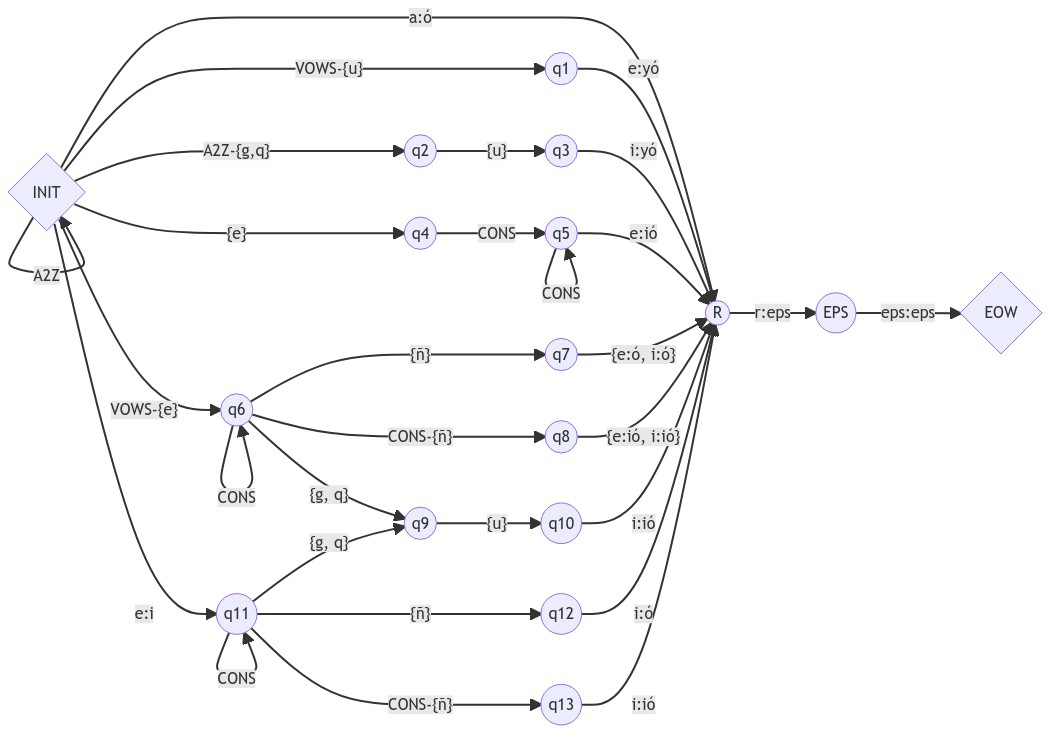
Here is a graph of the Spanish verb Finite State Transducer.
Here are some example verbs parsed by the Spanish FST.
| Rule | Infinitive | Actual Conjugate | Parsed Conjugate |
|---|---|---|---|
| -Car : -Có | vacilar | vaciló | vaciló |
| -Var : -Vó | boletear | boleteó | boleteó |
| -Cer : -Ció | pretender | pretendió | pretendió |
| -Cir : -Ció | redimir | redimió | redimió |
| -guir : -guió | extinguir | extinguió | extinguió |
| -quir : -quió | chasquir | chasquió | chasquió |
| -ñer : -ñó | tañer | tañó | tañó |
| -ñir : -ñó | fuñir | fuñó | fuñó |
| -Ver : -Vyó | caer | cayó | cayó |
| -Vir : -Vyó | instituir | instituyó | instituyó |
| -eCir : -iCió | proferir | profirió | profirió |
| -eCCir : -iCCió | servir | sirvió | sirvió |
| -eCCCir : -iCCCió | dehenchir | dehinchió | dehinchió |
| -eguir : -iguió | conseguir | consiguió | consiguió |
| -eñir : -iñó | estreñir | estriñó | estriñó |