







Photonics for Rust: validated, and visible while it runs.
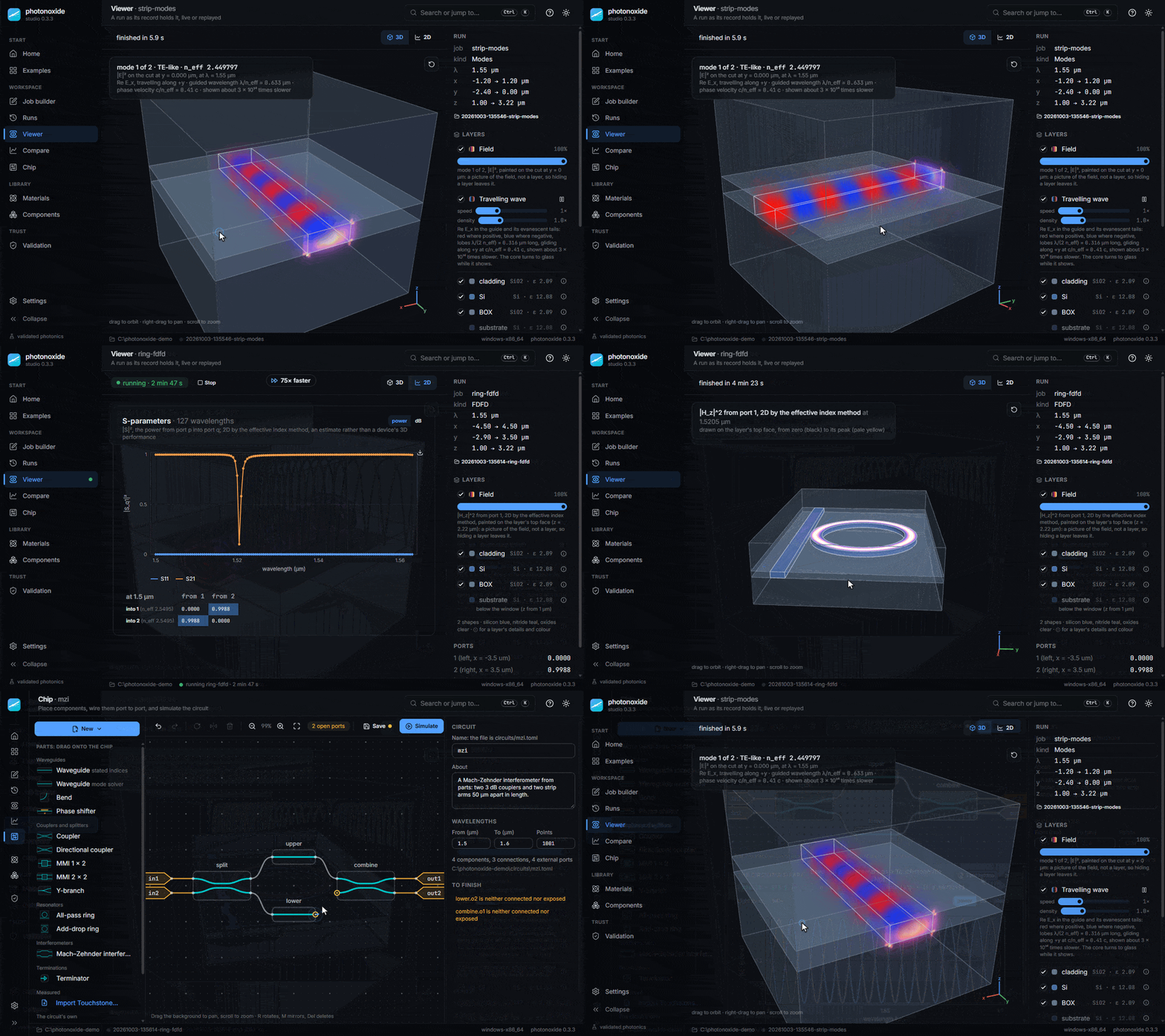
The studio: a strip's mode travelling in 3D; a ring's spectrum by 2D FDFD building up live (sped up) and the ring lit at resonance; an MZI wired on the chip and simulated.
photonoxide is a photonics library for Rust and a desktop studio to use it with. It solves waveguide modes, FDFD and FDTD in 2D and 3D, and circuits of components, with adjoint gradients throughout. Every method is checked against an analytic solution or a published result, in a validation report that CI keeps current.
It is released milestone by milestone (changelog, roadmap); until 1.0 the API can change between milestones. The methods, examples and report are also at tachsin.gr/projects/photonoxide.
-
Materials: dispersion models with their source, validity range and temperature; a catalogue of Si, SiO₂, SiN, LiNbO₃, GaAs, AlGaAs, InGaP, InP and AlN, with χ⁽²⁾ and Pockels tensors.
-
Geometry for any device: shapes kept exact, from paths with Euler bends to regions defined by expressions; booleans and offsets, arrays and lattices, components drawn with named ports, stacks with partial etches and sidewalls, and 3D bodies and graded media; each solver reads it by points or by each cell's fill.
-
Modes: slabs and multilayers, full-vector cross-sections with PMLs, Hadley's scheme for dielectric corners, bends and dispersion; every mode in a region of the complex effective-index plane by contour integrals.
-
FDFD: 2D and 3D, with mode ports and S-parameters and adjoint gradients; photonoxide's own direct and iterative solvers, on every core (baselines); sweeps sped up by recycling, and farmed to worker processes here or on other machines (farming).
-
FDTD: 2D and 3D with CPMLs, subpixel smoothing, mode sources, monitors, dispersive media and adjoint gradients; a CPU kernel blocked in space and time, and an optional GPU one (wgpu).
-
Circuits: components, netlists, the circuit adjoint, compact models and Touchstone files; optimization with genoxide.
-
Devices: components that know their geometry: the strip and rib waveguides, bend, directional coupler, rings, MMIs, Y-branch and MZIs, each with its models from a closed form to 3D and their errors; computed at a fidelity, swept over one or two parameters and taken through a process's corners, as jobs.
-
External solvers, optional: oneMKL's PARDISO, MUMPS, SuperLU, Apple Accelerate, NVIDIA cuDSS and Krylov solvers on NVIDIA GPUs, and any BLAS and LAPACK as the dense kernels of photonoxide's own solver, loaded at run time when installed and checked against photonoxide's own, which
autoleaves only for one measured faster here at the same accuracy (backends, install guides). -
Jobs and runs: YAML, TOML or JSON job files, checked before they run; every run is recorded and replays exactly.


Getting started · API · Examples · What works in Rust, Python and MATLAB
photonoxide opens a window on a folder of jobs, runs and chips: the examples, each run in one
click and checked against its paper; each component on its own page, its design in 3D, its models
side by side, its runs, sweeps and corners; the Custom device for any other structure; runs played live or
replayed (modes, fields, spectra, FDTD as the field propagates); the Academy's lessons with live
charts; the materials catalogue; chips; the validation report; and the external
solvers this machine has. The same program runs a job from the command line
(photonoxide run job.yaml, --headless for batches). studio/README.md has
every page and command.
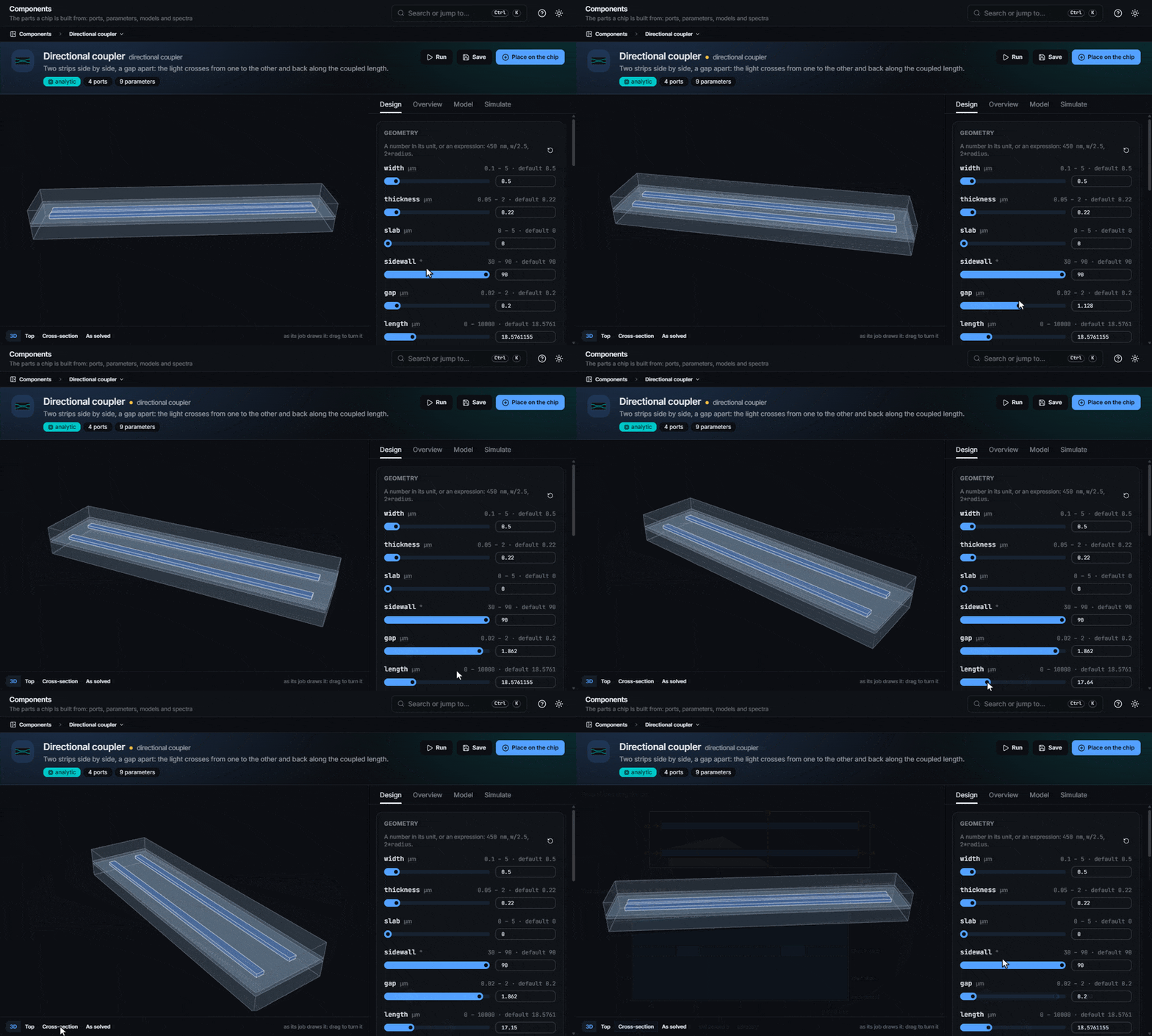 Components: a directional coupler's gap and length moved, its 3D view following; then its cross-section. |
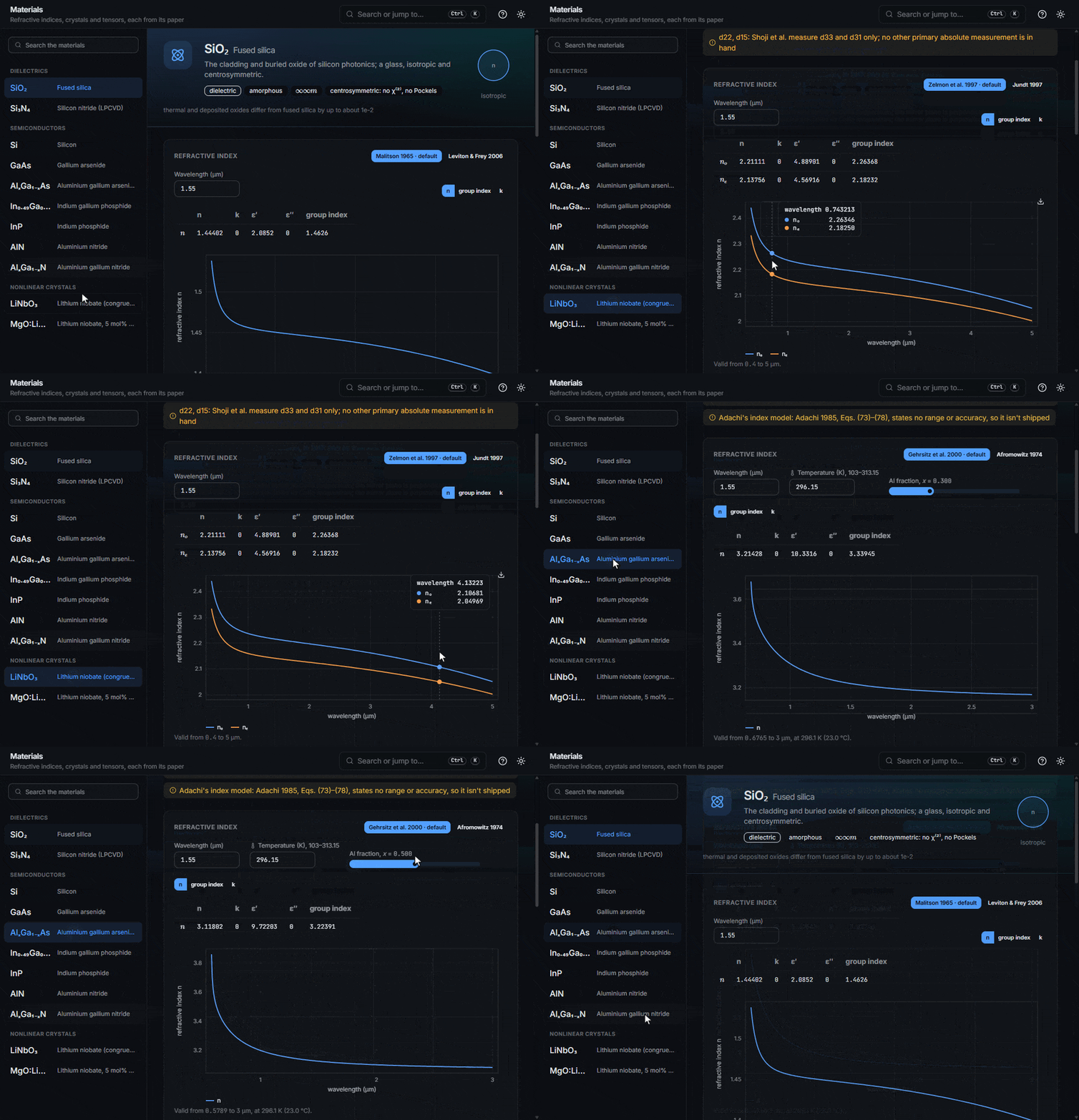 Materials: LiNbO₃'s no and ne read off the plot; AlGaAs as its aluminium fraction moves. |
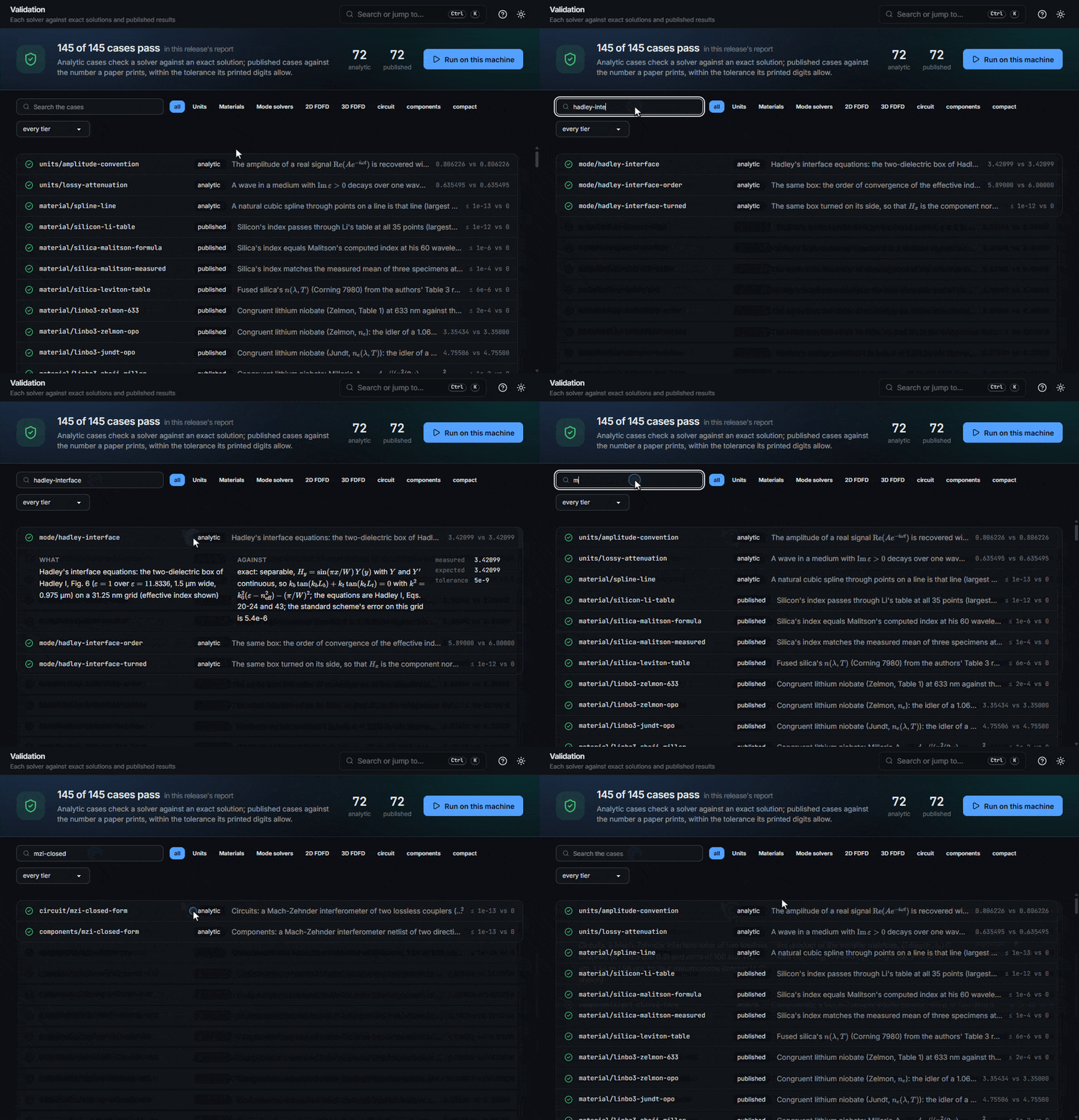 Validation: cases looked up and opened, each against its exact solution or paper. |
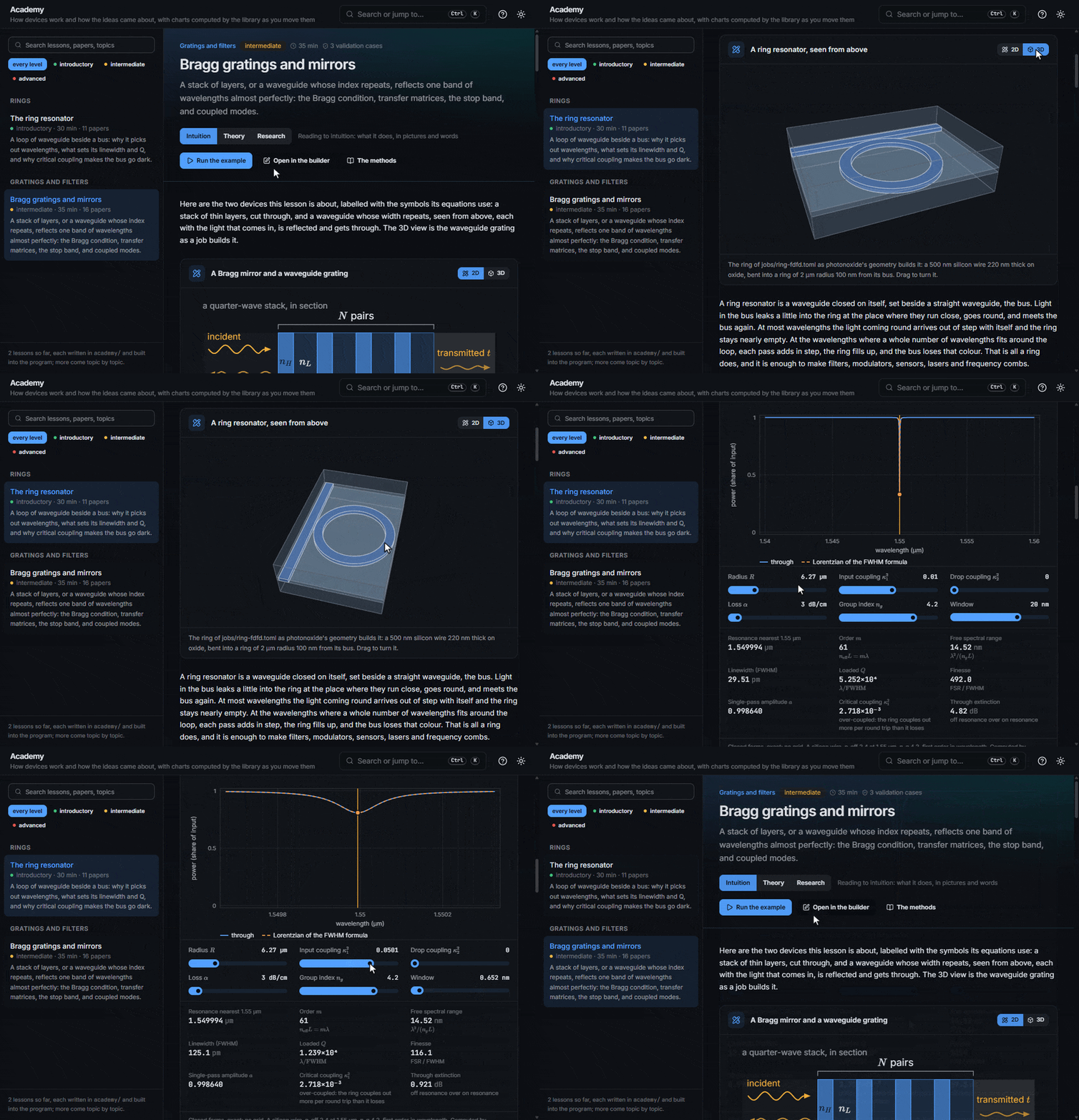 Academy: the ring resonator's lesson opens on its device, drawn and in 3D; then its transmission follows the coupling as the slider moves, critical coupling at the dip's zero. |
Rust:
cargo add photonoxidePure Rust, with no C, Fortran or Python dependencies.
Python 3.10 or later, wheels for Linux, macOS and Windows, with uv:
uv add photonoxide          # in a uv project
uv pip install photonoxide  # or into the active environment
pip install photonoxide works too: the guide is docs/python.md, the
API reference has every function. MATLAB uses the
Python package: docs/python.md.
The studio: the photonoxide program for Linux (x86_64 and ARM64), Windows and macOS is on
each release, and updates itself
(downloads, channels).
220 nm of silicon in oxide at 1550 nm, each material with its published dispersion, and the slab's modes solved exactly. In Rust:
use photonoxide::material::{silica, silicon};
use photonoxide::mode::Polarization;
use photonoxide::mode::slab::Slab;
use photonoxide::units::{Length, Wavelength};

fn main() -> photonoxide::Result<()> {
    let wavelength = Wavelength::um(1.55)?;
    let si = silicon().refractive_index(wavelength)?.re; // Li 1980
    let oxide = silica().refractive_index(wavelength)?.re; // Malitson 1965
    let slab = Slab::new(oxide, si, oxide, Length::nm(220.0))?;
    for (name, polarization) in [("TE", Polarization::Te), ("TM", Polarization::Tm)] {
        for mode in slab.modes(polarization, wavelength) {
            println!("{name}{}: n_eff = {:.4}", mode.order(), mode.effective_index());
        }
    }
    Ok(())
}
In Python:
import photonoxide as phox

si = phox.refractive_index("si", wavelength_um=1.55).real    # Li 1980
ox = phox.refractive_index("sio2", wavelength_um=1.55).real  # Malitson 1965
for polarization in ("te", "tm"):
    for mode in phox.slab_modes(below=ox, core=si, above=ox, thickness_um=0.22,
                                polarization=polarization, wavelength_um=1.55):
        print(f"{polarization.upper()}{mode.order}: n_eff = {mode.effective_index:.4f}")
Both print TE0: n_eff = 2.8475 and TM0: n_eff = 2.0531. Each of the
examples reproduces one paper's numbers and fails when it disagrees:
cargo run --release --example strip_waveguide # or: just example strip_waveguideYou need:
- Rust, the latest stable through rustup (
rustup update), 1.95 at least. Each Rust release brings its own LLVM, so a newer toolchain is also a newer code generator. - just for the commands below. It is optional: each recipe in the justfile is one plain command.
- For the studio: Node.js and pnpm, and on Linux WebKitGTK and Tauri's other prerequisites (studio/README.md).
- For the Python package: uv.
git clone https://github.com/tachsin/photonoxide
cd photonoxide
just build         # the library, in release mode
just test          # the unit tests
just studio        # the program as released, target/dist/photonoxide
just python-test   # the Python package in python/.venv, and its tests
just               # every recipe
The workspace has three optimized profiles:
| Profile | Settings | Used for |
|---|---|---|
release |
Cargo's defaults: opt-level = 3, LTO within each crate only, 16 codegen units |
CI, the tests and examples, a plain pnpm tauri build, the nightly builds |
dist |
release, with lto = "thin" and codegen-units = 1 |
the released program and the Python wheels; just studio, just build-dist |
fastest |
dist, with lto = "fat" |
just build-fastest |
LTO across crates lets LLVM optimize photonoxide together with faer, which does its sparse LU, and one codegen unit lets it see each crate whole. Both make the build slower. For the fastest code on your own machine, also compile for its CPU:
just build-fastest
# without just:  RUSTFLAGS="-C target-cpu=native" cargo build --profile fastest
# in PowerShell: $env:RUSTFLAGS = "-C target-cpu=native"; cargo build --profile fastest
That build uses every instruction set the CPU has (AVX2, AVX-512, …), so it runs only on CPUs that have them.
Nothing is merged without an analytic test, a reproduction of a published result and a convergence test; adjoint gradients are checked against finite differences. Each case in the report states its source, tolerance and grid, and CI fails when a case fails or the committed report isn't the one the code writes. CI checks every example's output too.
| Milestone | Scope | Status |
|---|---|---|
| 0.1 – 0.3 | Units and materials, mode solvers, FDFD in 2D and 3D, the studio | ✅ released |
| 0.4 – 0.4.3 | Components and circuits, compact models, a 3D preconditioner, multifrontal direct solves | ✅ released |
| 0.5 FDTD | 2D and 3D, CPML, smoothing, sources, monitors, adjoints, a GPU kernel; solver backends loaded at run time | ✅ released |
| 0.5.1 Channels and backends | Nightly built from main, MUMPS, SuperLU and Accelerate, the backend chosen from benchmarks, every mode in a region | ✅ released |
| 0.5.2 Many solves at once | Ports as a block, recycling across sweeps, more contour-integral mode solvers, farming across processes | ✅ released |
| 0.5.3 QMR without the matrix | QMR without its matrix where the matrix wouldn't fit, MUMPS 5.9 | ✅ released |
| 0.5.4 Geometry and devices | Geometry for any device; the device library on pages of its own, with its models, runs, sweeps, corners and optimization; compact models; the chip built from devices; devices in Python and MATLAB | ✅ released |
| 0.5.5 Writing jobs and taking results away | The job editor (the text beside the design, a popover of fields and expressions, a schema), YAML first, every example as a job too, exports of modes and fields in compressed files, GDS read into jobs | planned |
| 0.6 Thermal and electro-optic | Heat, thermo-optic phase shifters, Pockels modulators, travelling-wave electrodes | 🚧 next |
| 0.6.1 Nonlinear integrated optics | Transparency windows, phase matching, SHG, SFG, DFG, SPDC and FWM in waveguides, Kerr combs | planned |
| 0.6.2 Quantum light | Linear-optical statistics, photon-pair sources, Gaussian states, loss budgets of quantum circuits | planned |
| 0.6.3 Eigenmode expansion and the mode solver's tools | Eigenmode expansion, convergence to a tolerance, adaptive sweeps, effective area and fibre coupling, sidewall-roughness loss | planned |
| 0.7 Inverse design | Topology and shape optimization with fabrication constraints | planned |
| 0.7.1 – 0.16 | Distributed memory, carrier modulators, layout, RCWA and beam propagation, a device library, photonic crystals, plasmonics, nonlinear FDTD | planned |
| 1.0 | A stable API | planned |
ROADMAP.md has the details, with what each item measured.
- Validated: every number from a checked method, with its grid.
- Pure Rust: libraries you install yourself are optional backends, loaded at run time and never required (the plan).
- Reproducible: the same bits on any number of threads; every run replays.
- Visible: the studio and the command line run the same job.
Ideas, use cases and validation cases are as welcome as code: open an issue. CONTRIBUTING.md says what a pull request needs.
Licensed under either of Apache License, Version 2.0 or MIT license at your option.
Unless you explicitly state otherwise, any contribution intentionally submitted for inclusion in photonoxide by you, as defined in the Apache-2.0 license, shall be dual licensed as above, without any additional terms or conditions.