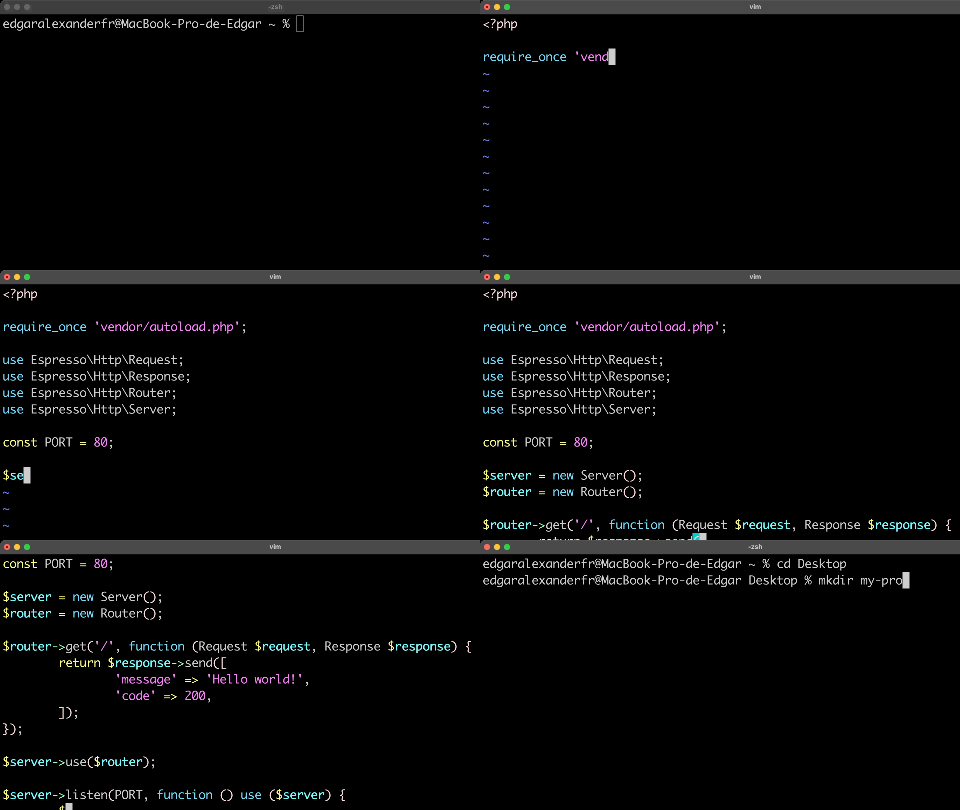


PHP Espresso is a small PHP Framework I created to develop runtime web servers for PHP running CLI programs and scripts. Very similar to frameworks like Express for NodeJS, Gorilla Mux for Golang, etc.
IMPORTANT NOTE: This is just a proof of concept to test the reliability of a runtime web server for PHP, its use and implementation is discouraged for production-level projects as it's an experimental framework for learning purposes.
PHP was designed to be a Single-Threaded Non-Asynchronous programming language, hence, the implementation of these type of web servers is very difficult as there will be always blocking processes for each request, hence, this server/framework is non-scalable.
- 3.1 Creating a basic web server
- 3.2 Serving a basic static HTML Page
- 3.3 Create a POST request
- 3.4 Complete Rest API CRUD example
- 3.5 Defining middlewares
- 3.6 Asynchronous programming
- PHP 8.0.0 or major
- Have PHP sockets module installed and enabled
- Composer
- Have a initted Composer project
Install PHP Espresso via Composer:
composer require edgaralexanderfr/php-espressoCreate a server.php file inside your project with the following program:
<?php

require_once 'vendor/autoload.php';

use Espresso\Http\Request;
use Espresso\Http\Response;
use Espresso\Http\Router;
use Espresso\Http\Server;

const PORT = 80;

$server = new Server();
$router = new Router();

$router->get('/', function (Request $request, Response $response) {
    return $response->send([
        'message' => 'Hello world!',
        'code' => 200,
    ]);
});

$server->use($router);

$server->listen(PORT, function () use ($server) {
    $server->log('Listening at port ' . PORT . '...');
});
Run the server:
php server.php # Use sudo if necessary for port 80Visit http://localhost or execute:
curl http://localhostAnd voila! 🎉
<?php

require_once 'vendor/autoload.php';

use Espresso\Http\Request;
use Espresso\Http\Response;
use Espresso\Http\Router;
use Espresso\Http\Server;

$server = new Server();
$router = new Router();

$router->get('/php-espresso-page', function (Request $request, Response $response) {
    return $response->setPayload(
        <<<HTML
            <!DOCTYPE html>
            <html lang="en">
                <head>
                    <title>My Web Page with PHP Espresso!</title>
                </head>
                <body>
                    <h1>My Web Page with PHP Espresso!</h1>

                    <p>This page was served using PHP Espresso.</p>
                </body>
            </html>
        HTML
    );
});

$server->use($router);

$server->listen(80, function () use ($server) {
    $server->log('Listening at port 80...');
});
Visit http://localhost/php-espresso-page in your browser.
<?php

require_once 'vendor/autoload.php';

use Espresso\Http\Request;
use Espresso\Http\Response;
use Espresso\Http\Router;
use Espresso\Http\Server;

$server = new Server();
$router = new Router();

$router->post('/users', function (Request $request, Response $response) {
    $body_json = $request->getJSON();

    return $response->send([
        'message' => 'User created successfully',
        'code' => 201,
        'user' => $body_json,
    ], 201);
});

$server->use($router);

$server->listen(80, function () use ($server) {
    $server->log('Listening at port 80...');
});
Execute a POST request:
curl -X POST http://localhost/users -d '{"name":"Alexander The Great"}'<?php
require_once 'vendor/autoload.php';
use Espresso\Http\Request;
use Espresso\Http\Response;
use Espresso\Http\Router;
use Espresso\Http\Server;
/** @var stdClass[] */
$users = [];
/** @var int */
$users_id = 1;
$server = new Server();
$router = new Router();
$router->get('/users', function (Request $request, Response $response) use (&$users) {
return $response->send($users);
});
$router->get('/users/:id', function (Request $request, Response $response) use (&$users) {
$id = $request->getId();
foreach ($users as $user) {
if (isset($user->{'id'}) && $user->id == $id) {
return $response->send($user);
}
}
return $response->send([
'message' => 'User not found',
'code' => 404,
], 404);
});
$router->post('/users', function (Request $request, Response $response) use (&$users, &$users_id) {
$body = $request->getJSON();
$email = $body->email ?? null;
$name = $body->name ?? null;
if (!$email || !$name) {
return $response->send([
'message' => 'Email and Name are required',
'code' => 400,
], 400);
}
$user = (object) [
'id' => $users_id++,
'email' => $email,
'name' => $name,
];
$users[] = $user;
return $response->send([
'message' => 'User created successfully',
'code' => 201,
'user' => $user,
], 201);
});
$router->patch('/users/:id', function (Request $request, Response $response) use (&$users) {
$id = $request->getId();
$body = $request->getJSON();
foreach ($users as &$user) {
if (isset($user->{'id'}) && $user->id == $id) {
$user->email = $body->email ?? $user->email;
$user->name = $body->name ?? $user->name;
return $response->send([
'message' => 'User updated successfully',
'code' => 200,
'user' => $user,
]);
}
}
return $response->send([
'message' => 'User not found',
'code' => 404,
], 404);
});
$router->delete('/users/:id', function (Request $request, Response $response) use (&$users) {
$id = $request->getId();
foreach ($users as $i => &$user) {
if (isset($user->{'id'}) && $user->id == $id) {
array_splice($users, $i, 1);
return $response->send([
'message' => 'User deleted successfully',
'code' => 200,
]);
}
}
return $response->send([
'message' => 'User not found',
'code' => 404,
], 404);
});
$server->use($router);
$server->listen(80, function () use ($server) {
$server->log('Listening at port 80...');
});Create a couple of users:
curl -X POST http://localhost/users -d '{"email":"[email protected]","name":"John Doe"}'
curl -X POST http://localhost/users -d '{"email":"[email protected]","name":"Jane Doe"}'
Retrieve all created users:
curl http://localhost/usersRetrieve user with id 2:
curl http://localhost/users/2Update user with id 1:
curl -X PATCH http://localhost/users/1 -d '{"name":"John James Doe"}'Delete user with id 2:
curl -X DELETE http://localhost/users/2PHP Espresso supports global and route middlewares. You can assign as much middlewares to a single route as you want.
To do so, you can create a new middlewares.php file and add the following code:
<?php

require_once 'vendor/autoload.php';

use Espresso\Http\Request;
use Espresso\Http\Response;
use Espresso\Http\Router;
use Espresso\Http\Server;

define('AUTH_CREDENTIALS', (object) [
    'user' => '[email protected]',
    'pass' => '1234567890', // Please... don't...
]);

/**
 * Middleware for admin authentication.
 */
function auth(Request $request, Response $response, callable $next)
{
    $authorization = $request->getHeader('Authorization') ?? '';
    $auth = explode(' ', $authorization);
    $type = $auth[0] ?? '';
    $token = $auth[1] ?? '';

    $credentials = explode(':', base64_decode($token));
    $user = $credentials[0] ?? null;
    $pass = $credentials[1] ?? null;

    if ($type != 'Bearer' || $user != AUTH_CREDENTIALS->user || $pass != AUTH_CREDENTIALS->pass) {
        return $response->send([
            'message' => Espresso\Http\CODES[401],
            'code' => 401,
        ], 401);
    }

    $next();
}

/** @var stdClass[] */
$users = [];
/** @var int */
$users_id = 1;

$server = new Server();
$router = new Router();

// Global middleware to check service status:
$server->use(function (Request $request, Response $response, callable $next) use ($argv) {
    $status = $argv[1] ?? '';

    if ($status == 'service-closed') {
        return $response->send([
            'message' => 'Service unavailable temporary due to maintenance',
            'code' => 503,
        ], 503);
    }

    $next();
});

$router->get('/users', function (Request $request, Response $response) use (&$users) {
    return $response->send($users);
});

$router->post('/users', 'auth', function (Request $request, Response $response) use (&$users, &$users_id) {
    $body = $request->getJSON();

    $email = $body->email ?? null;
    $name = $body->name ?? null;

    if (!$email || !$name) {
        return $response->send([
            'message' => 'Email and Name are required',
            'code' => 400,
        ], 400);
    }

    $user = (object) [
        'id' => $users_id++,
        'email' => $email,
        'name' => $name,
    ];

    $users[] = $user;

    return $response->send([
        'message' => 'User created successfully',
        'code' => 201,
        'user' => $user,
    ], 201);
});

$server->use($router);

$server->listen(80, function () use ($server) {
    $server->log('Listening at port 80...');
});
If you run:
php middlewares.php service-closedAnd do:
curl http://localhost/usersOr:
curl -X POST http://localhost/users -d '{"email":"[email protected]","name":"John Doe"}'You will get the following message:
{"message":"Service unavailable temporary due to maintenance","code":503}If you kill the previous server with CTRL+C and then run:
php middlewares.phpYou will be able to retrieve the users list now, e.g:
curl http://localhost/usersTo create a new user you need to be authenticated, to do so, assign an encoded Bearer Token using base64 to a variable and then pass the Authorization Header to curl command:
AUTH_TOKEN=$(echo '[email protected]:1234567890' | base64)
curl -X POST http://localhost/users -d '{"email":"[email protected]","name":"John Doe"}' -H "Authorization: Bearer ${AUTH_TOKEN}"It's still possible to do asynchronous programming with PHP Espresso by creating an asynchronous server and using the async and $next functions and callables:
<?php

require_once 'vendor/autoload.php';

use function Espresso\Event\async;
use Espresso\Http\Request;
use Espresso\Http\Response;
use Espresso\Http\Router;
use Espresso\Http\Server;

const SMALLER_FILE_PATH = __DIR__ . '/files/smaller-file.txt';
const BIGGER_FILE_PATH = __DIR__ . '/files/bigger-file.txt';

function read_file(string $path, int $bytes, callable $callable = null): void
{
    $file = fopen($path, 'r');
    $file_size = filesize($path);
    $content = '';
    $read_bytes = 0;

    async(function () use ($bytes, $callable, &$file, $file_size, &$content, &$read_bytes) {
        if ($read_bytes < $file_size) {
            $chunk_size = min($file_size - $read_bytes, $bytes);
            $chunk = fread($file, $chunk_size);
            $content .= $chunk;
            $read_bytes += $chunk_size;

            return false;
        }

        if ($callable) {
            $callable($content);
        }
    });
}

$server = new Server();
$router = new Router();

$router->get('/read-file', function (Request $request, Response $response, callable $next) {
    $size = $request->getParam('size');

    $file_path = $size == 'big' ? BIGGER_FILE_PATH : SMALLER_FILE_PATH;

    read_file($file_path, 8, function (string $content) use ($request, $response, $next, $size) {
        $response->send([
            'file_content' => $content,
            'size' => $size,
        ]);

        $next();
    });
});

$server->use($router);
$server->async(true);

$server->listen(80, function () use ($server) {
    $server->log('Listening at port 80...');
});
The async function initiates an Event Looper inside of the listen method when running in async mode by setting $server->async(true);.
async may return a boolean value (false) when the async call is not done yet and returns true or nothing when it's finished.
In this example, the async call inside of the read_file function will return false as long as the requested file is not completed yet, this by reading $bytes as a step for each chunk read through every call inside the Event Loop as an asynchronous process.
Once the whole file is read, the $callable callback will be called, passing in the content of the file on the async call by returning nothing at the very end of the function.
If you execute:
curl 'http://localhost/read-file?size=big'\
& curl 'http://localhost/read-file?size=small'\
& wait
The smaller file request will respond earlier than the larger file request despite of being executed right at the same time.
This could be a way to implement asynchronous programs and libraries for streaming, networking, databases, files, I/O operations, etc, although it's not perfect, it would require a vast work to implement lots of PHP libraries that were designed initially to be Single-Threaded and Synchronous.
Maybe the future of PHP is promising for this purpose with the introduction of tools like Fibers and stuff, but yet, we will see how it goes. 🙂🐘