
One local-first platform for workflows, data, AI, and apps.
Build end-to-end use cases visually, keep terabytes of data in-platform, and run
anywhere — laptop, server, phone, or edge. Offline by default, cloud-ready when you need it.





Try online · Download · Docs · Compare · Discord
Flow-Like is a source-available, local-first platform for building end-to-end use cases — workflows, data, AI, and apps in one runtime. Instead of stitching together an automation tool (n8n, Zapier), an app builder (Retool), an AI framework, and separate data infrastructure, you build the whole thing in one place — with a native data layer that holds terabytes in-platform, a fully typed execution engine, and complete lineage on every run. Runs on your laptop, server, phone, or edge. No forced cloud, no black boxes.

1,500+ nodes · 15 languages · runs offline · terabytes in-platform · zero external services
- A private RAG assistant over your own PDFs and files — local embeddings and a local LLM, no API keys, nothing leaving your machine.
- Data pipelines at scale — ingest, transform, and store terabytes in-platform, then expose the result as an app.
- Agentic automations — scrape, enrich, and act across APIs, databases, Slack, and email, on a schedule or a webhook.
- Internal & customer-facing apps — a custom UI backed by your workflows and built-in storage, shipped to desktop, web, or edge.
| Try online | Desktop app | From source |
|---|---|---|
| app.flow-like.com — no install | Download for macOS · Windows · Linux | Build it yourself |
Runs where you choose — not where a vendor tells you. Your laptop, a private server, an air-gapped factory network, a Raspberry Pi, or cloud you control. Your data stays where you put it. Local-first by default; deploy to your own AWS/GCP/Azure when you're ready. No vendor lock-in, no "upgrade to enterprise for basic autonomy."
Fast enough to run on a phone. The engine is written in Rust — native code, no garbage collector, no interpreter overhead. That's what makes real workflows viable on constrained devices, and millions of executions trivial on a server.
| Flow-Like | Typical Node/Python engines | |
|---|---|---|
| Throughput | ~244,000 workflows/sec | ~200 workflows/sec |
| Latency | ~0.6 ms | ~50–500 ms |
Fully typed, fully traceable. Every workflow tracks what data flows where and why. Type-safe input/output contracts catch errors before deployment, and every input, transformation, and output is recorded with complete lineage — replay any run. View the same workflow three ways: Process for the business, Data for analysts, Execution for engineers.
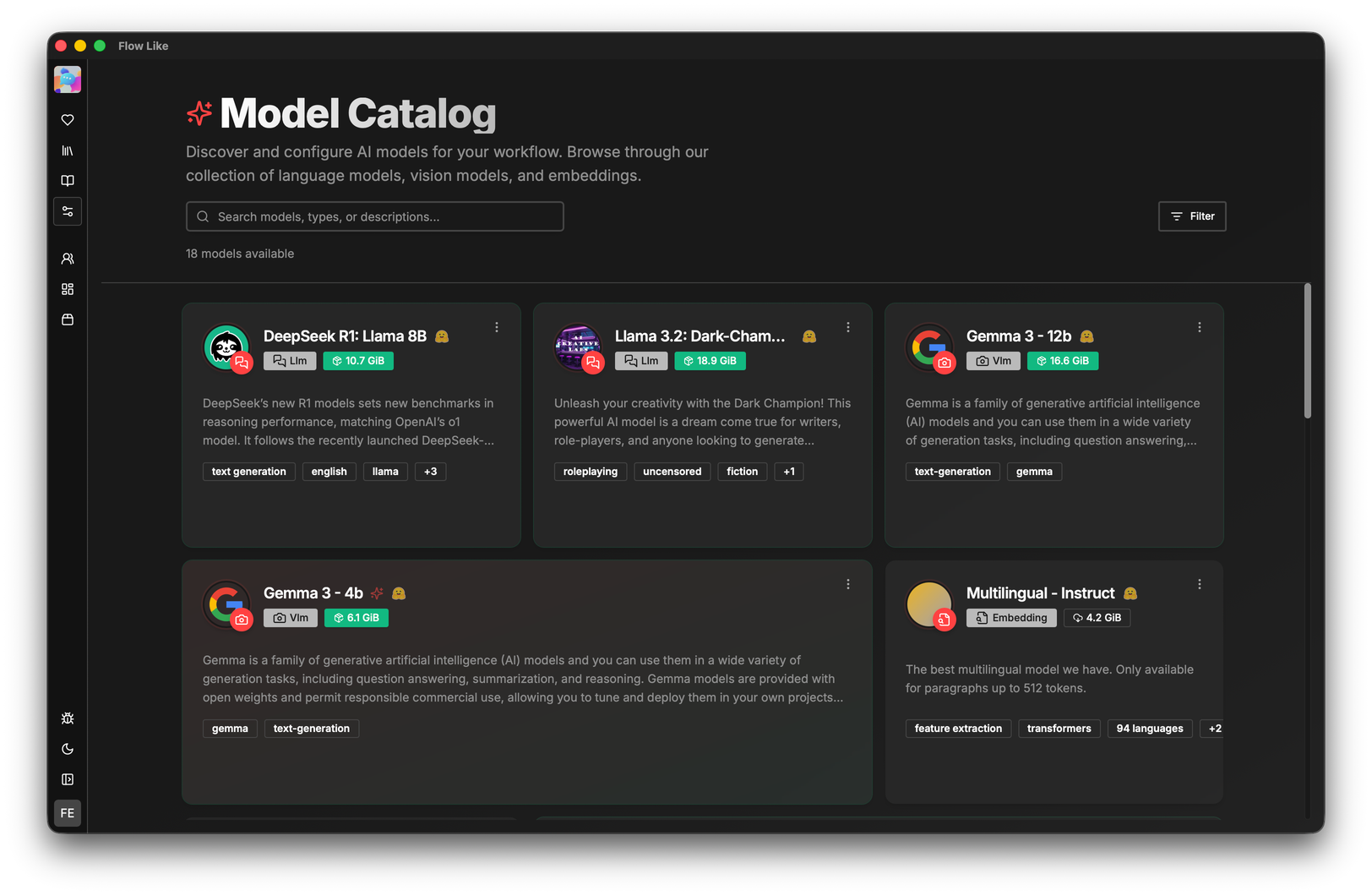
AI-native, and it runs on-device. LLMs, embeddings, vision object detection, speech-to-text, and text-to-speech all run locally — no API keys, no data leaving the machine — or in the cloud when you'd rather. Every model call is logged with full context (inputs, outputs, model version, reasoning trace), with approval gates and guardrails on every step.
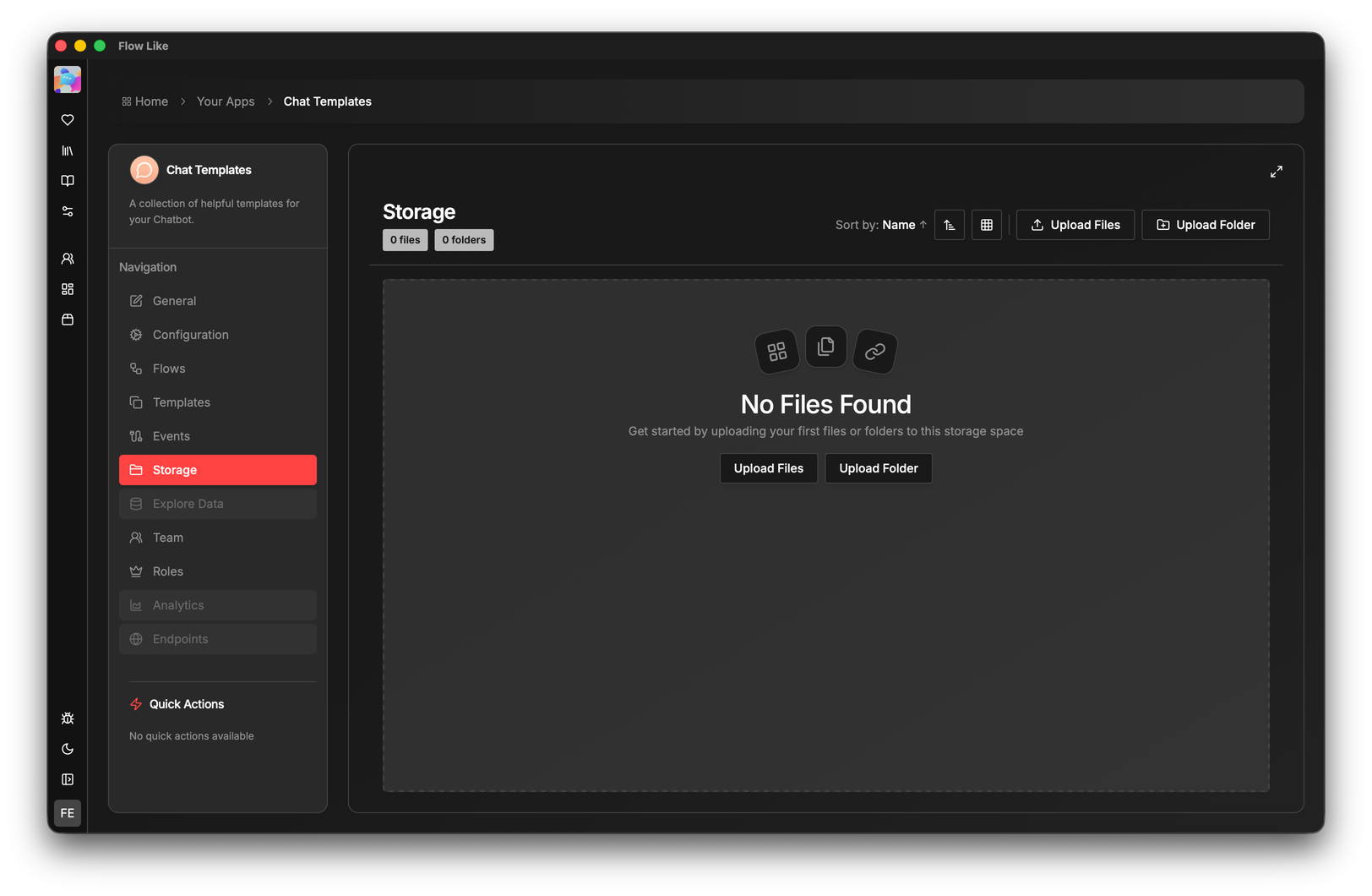
Your data lives in the platform — not bolted on. Most tools make you wire up an external database, object store, and warehouse before you can do anything real. Flow-Like ships a native data layer: files, tables, and hybrid keyword + vector search on the canvas, with unlimited payload sizes and terabytes of data held right where your workflows run — no external S3, Postgres, or warehouse to provision, no glue code, no egress surprises. Share datasets, apps, and templates across your team from the same system.
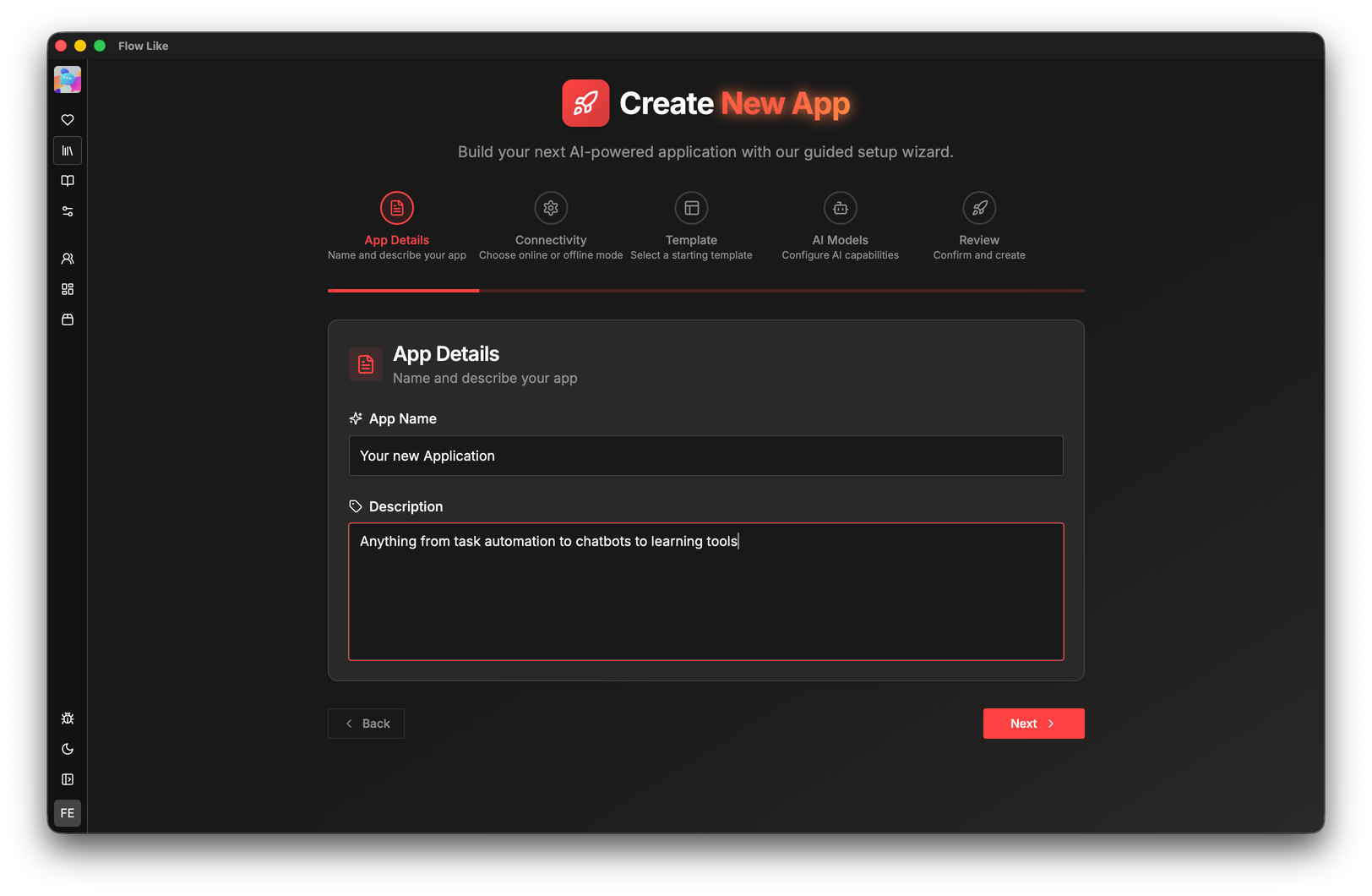
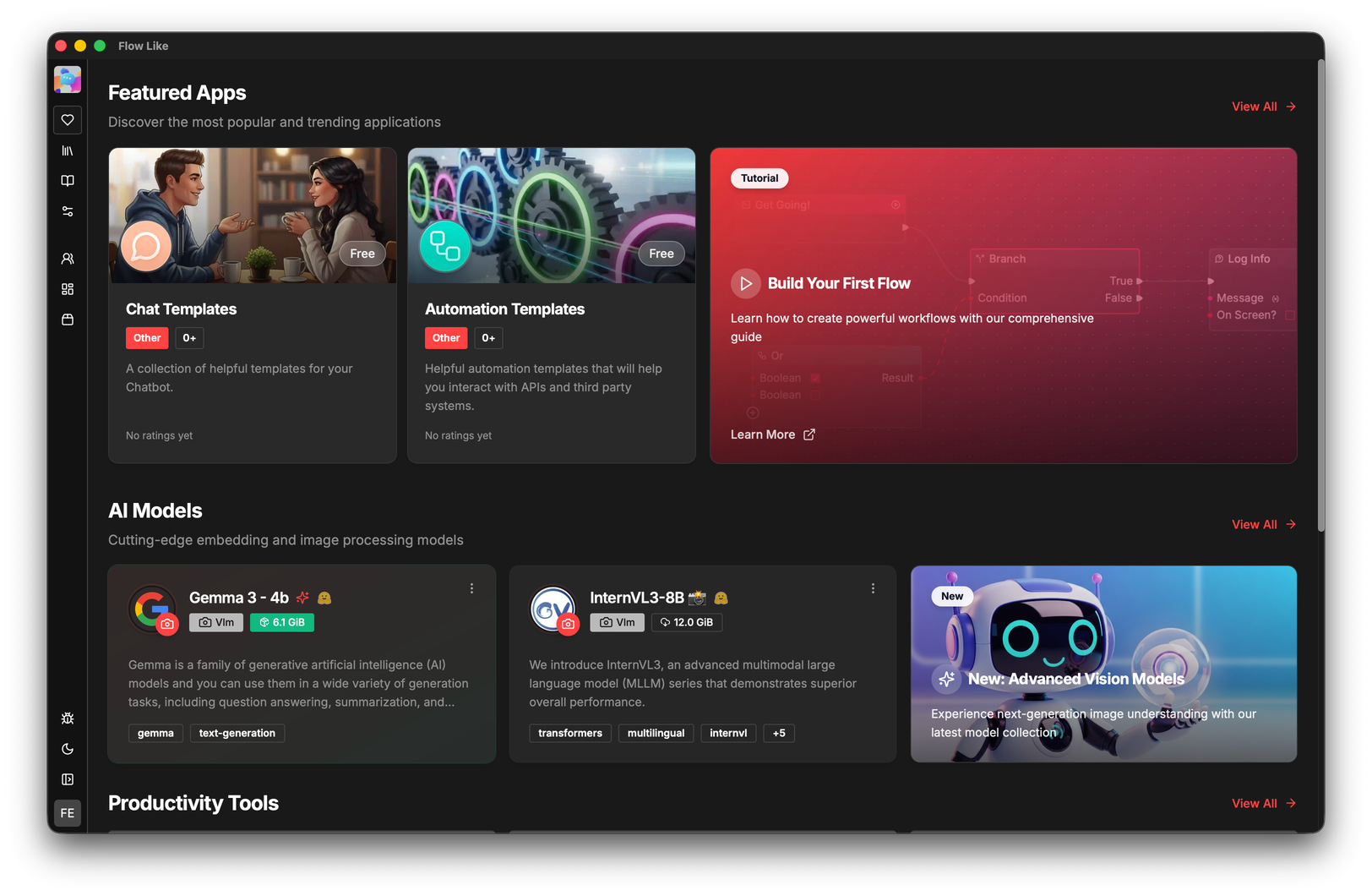
Ship apps, not just automations. Package workflows as installable apps with built-in storage and a no-code UI builder. Run them offline, share them, or embed the whole editor white-labeled in your own product.
Flow-Like isn't "a better n8n." Most stacks split the data, automation, AI, and app layers across separate products and leave you to integrate them. Flow-Like is a platform for building end-to-end use cases — data included — in one governed, high-performance runtime.
| Layer | The usual stack | In Flow-Like |
|---|---|---|
| Data & storage | S3 + Postgres + a warehouse | Native data layer — terabytes in-platform, unlimited payloads, hybrid search, no external infra |
| Workflows & automation | Zapier · n8n · Make | Built in, typed, and replayable |
| AI & agents | LangChain · Dify · CrewAI | On-device + cloud, with guardrails |
| Apps & UI | Retool · Appsmith | Ship desktop, web & mobile apps |
| Governance | bolted on, per tool | RBAC, audit trail & lineage across all of it |
The result: one platform instead of five tools plus the glue between them — running on your hardware, offline-capable, and shareable across your team.
Full head-to-head against 21 tools (n8n, Retool, Temporal, LangChain, Airflow, Palantir Foundry, UiPath, and more) → flow-like.com/compare
Flow-Like is source-available under the Business Source License (BSL 1.1), not an OSI open-source license yet. Here's exactly what that means so there are no surprises:
- ✅ Free for the vast majority of users. You can use it in production for free if your organization has fewer than 2,000 employees and under €300M in annual revenue. That covers virtually every startup, SMB, and team.
- ✅ Read, fork, modify, self-host, and contribute — the full source is here, and non-production use is always free.
- ⏳ It becomes open source on a timer. Each release automatically re-licenses under the MPL 2.0 on its Change Date. What ships today is guaranteed to become true open source.
- 💼 Two things need a commercial license: (1) building a product that directly competes with Flow-Like, and (2) large entities (2,000+ employees or €300M+ revenue).
We chose BSL to keep Flow-Like sustainable and independent while still shipping all the source and a guaranteed path to open source. Questions or a commercial license? Reach out or read the full license.
- Visual Workflow Studio — a no-code IDE with type-aware wiring, live validation, inline execution feedback, and snapshot debugging.
- 1,500+ built-in nodes — APIs & webhooks, databases, files (Excel/CSV/PDF), on-device AI (LLMs, vision object detection, speech-to-text, text-to-speech, embeddings), messaging (Slack, Discord, email), IoT, logic, auth — browse the catalog.
- Built-in data layer — object storage, tables, and hybrid keyword + vector search on the canvas. Terabytes in-platform, unlimited payloads, shareable across your team — no external services.
- Write nodes in 15 languages — custom nodes run as sandboxed WebAssembly, so extend the catalog in Rust, TypeScript, Python, Go, C#, Java, Swift, and more. Templates here.
- SDKs — control workflows programmatically from Node.js/TypeScript (
npm i @flow-like/sdk) or Python (uv add flow-like), with optional LangChain integration. SDK docs. - White-label — themes, brand design tokens, SSO (OIDC/JWT), per-tenant usage metering, and a headless engine. Embed the editor in your own product.
# Prerequisites: mise, Rust, Bun, Protobuf compiler, Tauri prerequisites
git clone https://github.com/Rheosoph/flow-like.git
cd flow-like
mise trust && mise install   # toolchains: Rust, Bun, Node, Python, uv
bun install                  # Node packages
mise run dev:desktop         # start the desktop app
Every dev/build/deploy task lives in mise.toml. Run mise tasks to list them, e.g. mise run dev:web, mise run build:desktop, mise run check. Platform-specific notes are in the docs.
Flow-Like is built in the open and we'd love your help — new nodes, bug fixes, docs, themes, or ideas.
- 🌱 Good first issues — a friendly place to start.
- 📖 CONTRIBUTING.md — setup and guidelines.
- 💬 Discord — questions, help, and discussion.
If Flow-Like is useful to you, star the repo — it genuinely helps others find the project.
Every avatar here shipped something. Yours could be next.
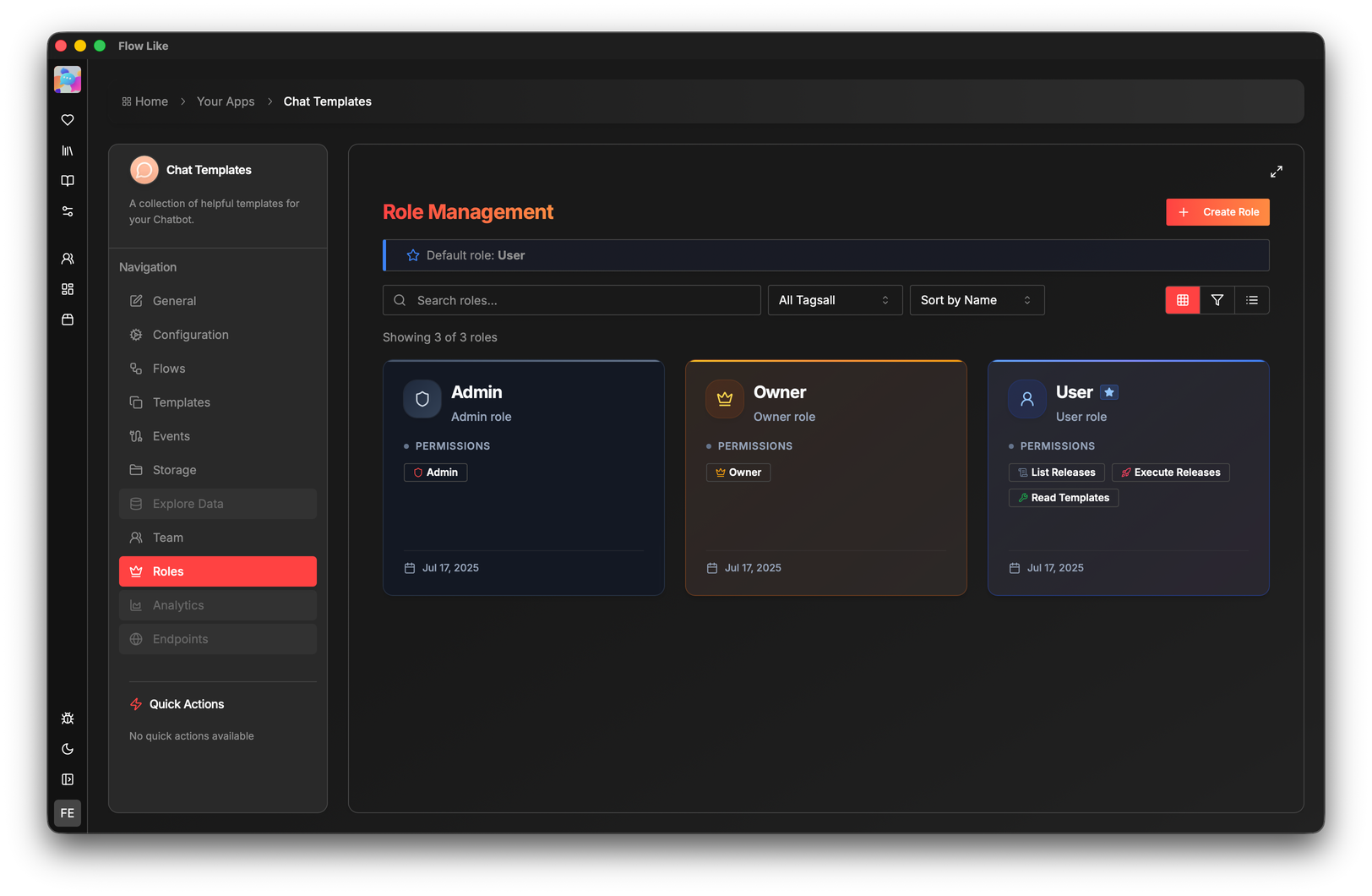
Screenshots
FAQ
Is it free? For almost everyone, yes — see Licensing. Under 2,000 employees and €300M revenue: free in production.
Can I run it fully offline? Yes, 100% — ideal for air-gapped and secure environments. Switch to online mode anytime to collaborate.
Can I embed it in my product? Yes. Flow-Like is white-label ready — embed the editor, theme it, wire up SSO, or run the engine headlessly.
What languages do I write? The builder is no-code. Custom nodes run as sandboxed WebAssembly, so you can write them in 15 languages — Rust, TypeScript, Python, Go, C#, Java, Kotlin, Swift, and more (see templates/). SDKs (TS/Python) and REST APIs cover programmatic control.
Is it production-ready? It's actively developed and used in production. Test thoroughly for mission-critical workflows; see releases.
How do I get support? Discord, Docs, or GitHub Issues.
Built with
Runtime: Rust · Tauri · Tokio · Axum · SeaORM AI/ML: llama.cpp · Candle · ONNX Runtime Frontend: Next.js · React Flow · shadcn/ui · Tailwind CSS Tooling: mise · Bun · Biome
Thank you to every maintainer and contributor of these projects.
Website · Docs · Blog · License · Code of Conduct · Security
Made with care in Munich, Germany.