
NVIDIA-accelerated, deep learned semantic image segmentation
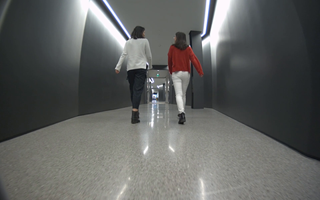

Isaac ROS Image Segmentation contains ROS packages for semantic image segmentation.
These packages provide methods for classification of an input image at the pixel level by running GPU-accelerated inference on a DNN model. Each pixel of the input image is predicted to belong to a set of defined classes. The output prediction can be used by perception functions to understand where each class is spatially in a 2D image or fuse with a corresponding depth location in a 3D scene.
| Package | Model Architecture | Description |
|---|---|---|
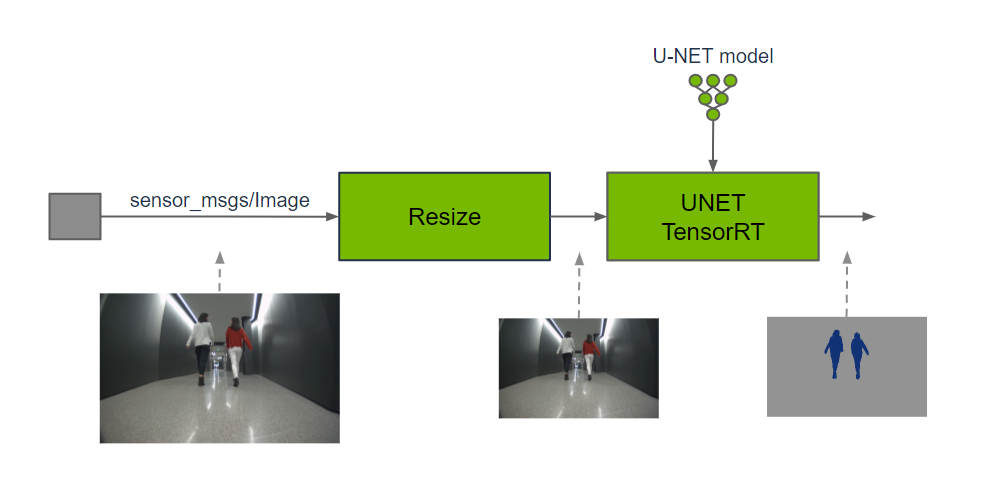
| Isaac ROS U-NET | U-NET | Convolutional network popular for biomedical imaging segmentation models |
| Isaac ROS Segformer | Segformer | Transformer-based network that works well for objects of varying scale |
| Isaac ROS Segment Anything | Segment Anything | Segments any object in an image when given a prompt as to which one |
| Isaac ROS Segment Anything2 | Segment Anything2 | Segments and tracks any object in a video stream when given a prompt as to which one |
Input images may need to be cropped and resized to maintain the aspect ratio and match the input resolution expected by the DNN model; image resolution may be reduced to improve DNN inference performance, which typically scales directly with the number of pixels in the image.
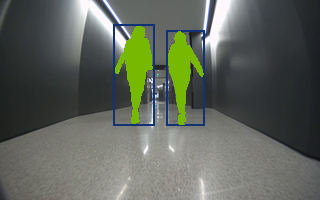
Image segmentation provides more information and uses more compute than object detection to produce classifications per pixel, whereas object detection classifies a simpler bounding box rectangle in image coordinates. Object detection is used to know if, and where spatially in a 2D image, the object exists. On the other hand, image segmentation is used to know which pixels belong to the class. One application is using the segmentation result, and fusing it with the corresponding depth information in order to know an object location in a 3D scene.
This package uses rosidl::Buffer, a feature built into ROS 2 Lyrical, to
avoid unnecessary copies of large payloads between CPU and accelerator
memory. The CUDA buffer backend builds on this native ROS 2 feature to provide
CUDA memory storage and transport. Most applications can use standard ROS
messages and conversion packages without depending directly on a buffer
backend. See rosidl::Buffer and Buffer Backends for details.
| Sample Graph |
Input Size |
AGX Thor T5000 |
AGX Thor T4000 |
AGX Orin |
Orin Nano Super 8GB |
DGX Spark |
x86_64 w/ RTX 5090 |
x86_64 w/ RTX 5070 |
|---|---|---|---|---|---|---|---|---|
| SAM Image Segmentation Graph Full SAM |
720p |
4.17 fps |
3.40 fps |
2.35 fps |
– |
3.18 fps |
24.8 fps |
8.41 fps |
| SAM Image Segmentation Graph Mobile SAM |
720p |
21.7 fps |
11.7 fps |
7.56 fps |
3.89 fps |
12.5 fps |
110 fps 9.9 ms @ 30Hz |
58.3 fps 18 ms @ 30Hz |
| TensorRT Graph PeopleSemSegNet |
544p |
466 fps 3.7 ms @ 30Hz |
353 fps 4.4 ms @ 30Hz |
316 fps 4.2 ms @ 30Hz |
155 fps 7.8 ms @ 30Hz |
316 fps 2.6 ms @ 30Hz |
1200 fps 1.2 ms @ 30Hz |
1010 fps 1.4 ms @ 30Hz |
Please visit the Isaac ROS Documentation to learn how to use this repository.
isaac_ros_segformerisaac_ros_segment_anythingisaac_ros_segment_anything2isaac_ros_segment_anything2_interfacesisaac_ros_unet
Update 2026-11-16: Compatibility and integration updates for the Isaac ROS 5.1.0 release