


connetto is the core of a data-driven application, built once so that each application does not have to build it. A team writes its PostgreSQL schema with the row-level security policies that say who sees what, its UI, and whatever the service itself does. connetto takes care of everything between the database and the screen.
On the server, the database's logical replication stream is the source of every update. subql, the change data capture engine connetto hosts, matches each committed change against every open subscription in process, folds aggregates incrementally, and re-executes only the query shapes that need it, so a change costs the server one evaluation rather than a query per client. Every row is authorized on every path, by Postgres RLS on snapshots and writes, and on the change path by the same policies translated by rls2fga into an OpenFGA model, so a change reaches only the callers allowed to see the row as it was. Login is OAuth 2.0 and OIDC against any provider, and connetto mints the sessions, the grants, and the capabilities through which an application shares a row.
On the client, a SQLite replica on native and in the browser is read with Diesel and written optimistically. Every write applies on the server under the database's own policies and comes back to every subscribed device, every subscribed read stays live, and the replica is encrypted at rest and keeps working offline.
| Area | Built |
|---|---|
| Sync loop | Optimistic writes applied under RLS, CDC through subql, live row subscriptions, reconnect with catch-up or resync |
| Aggregates | COUNT, SUM, AVG, variance and grouped folds per change, MIN, MAX, joins and rows re-executed per viewer |
| Identity | OAuth 2.0 and OIDC login, durable sessions, grants, shareable capabilities, audit table, throttling and bans |
| Authorization | RLS on snapshots and writes, the same policies as an OpenFGA model on the change path |
| Clients | One builder per platform, a native Diesel connection on desktop, Android and iOS, a browser client on a worker over OPFS, Dioxus and Yew hooks |
| At rest | SQLCipher and sqlite3mc with keyring or IndexedDB custody, passkey unlock in the browser and biometric or PIN unlock on Apple, Android and Windows, a device-private tier, retention, several accounts |
| Portability | Streamed device archives that restore the tier, unsent writes and unsent content |
| Files | Chunked, encrypted content with a file server and a client for both platforms, per-identity storage quotas and deployment storage and bandwidth ceilings answered with Retry-After |
| Schema | Postgres DDL translated to the replica at build time by pg2sqlite, with write guards |
| Operations | tracing logs everywhere, Docker and headless Chrome suites, CI over seven workspaces with proofs on an Android emulator and an iOS simulator |
The plan in plans/master-implementation-plan.md tracks 99 phases, 80 done and 19 open. The core is built and proven, and what remains is the last mile around it, plus one designed extension: an app system where a developer registers a program by its public key and the tables it wants, a user installs it on their own data, and the program runs as a bot user of the deployment under the user's own sharing rows (chapter 12).
| Remaining | Phases |
|---|---|
| One page codec, synced tables without local references | R21, R92 |
| Schema majors, shared public store, portability download | R31, R11, R61 |
| Backup and restore, clock discipline | R70, R72 |
| Demo gaps | R57 |
| Apps, installations and the bot template, the file replica for bots | R91, R93 |
| Device-to-device sync without a server | R74 to R80 |
| Share keys on a running client | R95 |
| The desktop login tab | R97 |
A per-check consistency token, Zanzibar's zookie, is not supported and owned by no phase, since OpenFGA lists it as future work. A withdrawn permission therefore takes effect on the change path within the read cache lifetime, while writes and teardowns are refused at once (chapter 08).
docs/architecture/README.md indexes the chapters. 00-overview.md is the entry point, open-questions.md the index of every numbered question and its decision. Every statement in a chapter carries a status marker, and a chapter outranks the plan on decisions while the plan outranks a chapter on phases.
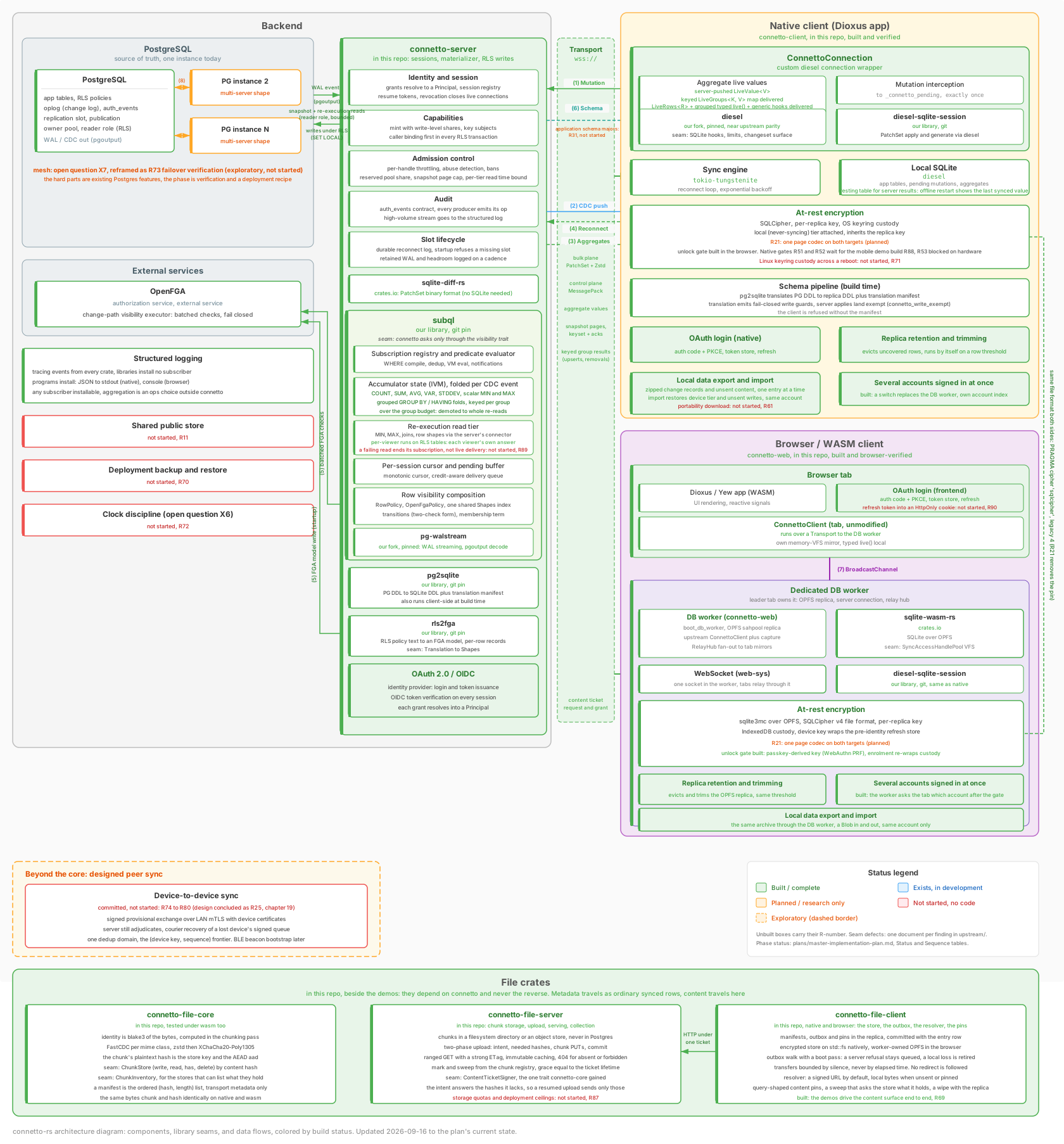
The drawing below is the whole system coloured by build status. It is too dense to read inline, so open it in the browser and zoom.
| Crate | Role |
|---|---|
connetto-core |
Wire protocol, framing, and the traits every side agrees on |
connetto-server |
Session manager, subscription materializer, auth stack, mutation handler, and the server builder that assembles them |
connetto-client |
Native Diesel connection, its builder, background sync, live queries, teardown, archives |
connetto-auth-session |
The platform browser tab a phone signs in through, returning to the app by redirect |
connetto-schema |
The build step translating a deployment's Postgres sources into the bundle client and server share |
connetto-web |
Browser platform on wasm32, the DB worker, the relay, storage and custody |
connetto-dioxus, connetto-yew |
Framework adapters exposing live queries as hooks |
connetto-file-core, connetto-file-server, connetto-file-client |
The file stack, which depends on connetto and never the reverse |
connetto-test-harness |
The in-process CDC loop and the browser stack runner behind the tests |
examples/ holds a Dioxus demo for desktop, Android and iOS, Dioxus and Yew web demos sharing one deployment, the browser smoke suite, and the passkey unlock proof.